
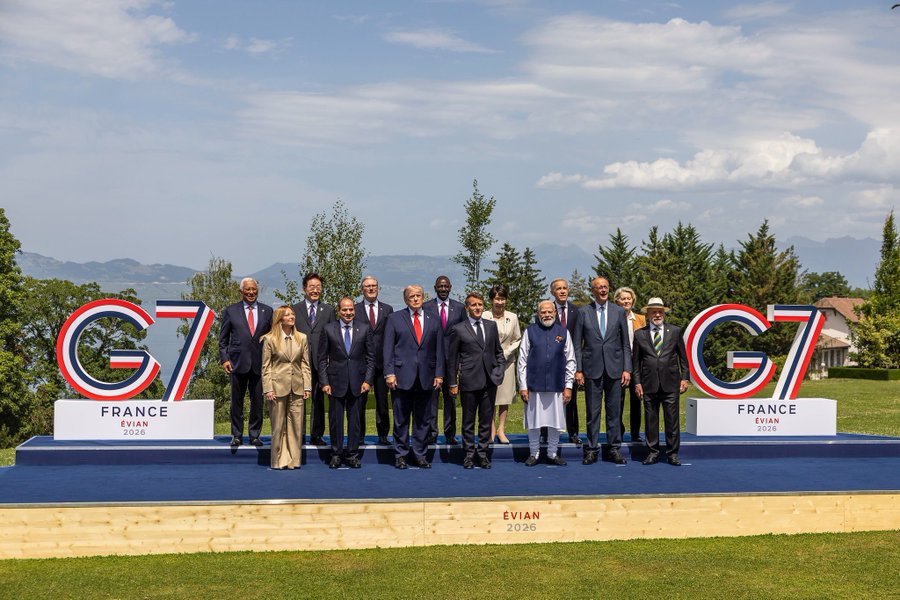
Évian, France, 17 June 2026 – As G7 leaders depart Évian-les-Bains, 350 says the summit has once again proven that the G7 is not fit for purpose and is a forum that exists to protect the interests of rich countries and fossil fuel companies rather than to deliver the rapid, fair transition the world urgently needs.
Energy, supply chain and commodity shocks triggered by the conflict between the US, Israel and Iran have driven up transport costs, threatened food security and reignited inflationary pressures around the world. G7 leaders needed to commit to the clean energy transition as the way out of fossil fuel volatility once and for all. Instead, climate change was conspicuously absent from the ministerial documents produced in the run-up to the summit, even as financing for nature and ocean protection found their way in.
Savio Carvalho, Campaigns & Networks at 350 “Every G7 summit now follows the same script: leaders acknowledge the scale of the crisis, then quietly let it slide off the agenda the moment it becomes politically inconvenient. Évian was meant to be different, given everything the past few months have shown us about fossil fuel dependence and volatility. Instead, climate and gender were sacrificed. That is not leadership. That is surrender. This G7 summit needed to deliver far more than it has. But it has proven once again that this forum exists to uphold the agenda of rich countries and fossil fuel companies, not the people who are already paying the price of this crisis.”
Rukiya Khamis, East Africa Programme Manager, said: “Kenya’s presence at the G7 is a monumental signal that Africa will no longer sit on the sidelines of global climate architecture. As we step forward to represent continental interests, our focus is unwavering: we demand binding commitments on climate adaptation and a definitive phase-out plan from the world’s heaviest polluters. The time for empty rhetoric has passed. Kenya is here to set a new tone, one where global partnerships deliver the equitable financing and technology transfer Africa rightfully deserves.”
Fanny Petitbon, 350 France Country Manager, said: “What we needed from Évian was a clear signal from the most powerful nations of the planet: a rapid phase-out of fossil fuels and a permanent tax on the companies posting record profits from the crisis. Under the French presidency, this summit became a race to the lowest common denominator, a deliberate choice to avoid upsetting Washington rather than to lead. President Macron had the chance to cement a legacy of real climate action but did not seize it. 70% of French people call for increased taxes on fossil fuel profits, yet their own government could not table the measure at a summit it was hosting. This forum was completely disconnected from the realities of the people it claims to serve. France is bracing for a massive heatwave, a brutal reminder that the climate crisis is not a future threat, it is here, now. Fossil fuel companies will keep on counting their profits while ordinary people will foot the bill in their energy bills and food prices.”
Ellie May, 350 UK Campaigner, said: “It should alarm everyone that the world’s most powerful democracies cannot even keep climate change on the agenda when the case for action has never been clearer. We are also watching climate diplomacy be dismantled in real time inside airconditioned rooms – not through any single dramatic decision, but through a thousand small acts of avoidance like this one.”
Masayoshi Iyoda, 350 Japan Campaigner said: “A new poll shows nearly 70% of Japanese business leaders say that Japan’s dependence on imported fossil fuels has left the country vulnerable to price shocks. But the call to shift to homegrown renewables has fallen on deaf ears, with Prime Minister Takaichi using taxpayer’s money to subsidize more fossil fuel use in Japan and overseas. The G7 not only failed to learn the lesson of this crisis: it acts like a gang bent on keeping ordinary people’s bills hostage to volatile fossil fuels.”
Candice Fortin, 350 US Campaigner, said: “Gender and climate were both quietly dropped from this summit’s agenda, and that is not a coincidence. Both demand a reckoning with power, and this G7 chose comfort over accountability at exactly the moment the world needed the opposite.”
Attiya Jaffar, 350 Canada Country Manager, said: “The communities already living with the consequences of this crisis through floods, droughts, and unaffordable energy bills, did not get a seat at this table. What they got instead was a summit more concerned with managing the Trump administration’s needs than managing a planetary emergency.”
The question of critical minerals also featured prominently in G7 discussions, but it’s crucial that this conversation extends beyond the narrow framework of the G7 to include the widest possible range of affected countries. Any decisions must fully take into account the rights, interests, and meaningful participation of those most impacted including local communities, Indigenous Peoples, and workers ensuring they have a real say in shaping outcomes that affect their lives.
350 is calling on world governments to use the months ahead to deliver what Évian failed to: a binding commitment to phase out fossil fuels rapidly and fairly, permanent and increased taxes on fossil fuel profits, and genuine investment in clean and secure energy systems
#### ENDS
About 350
350 is a global grassroots movement working to end the age of fossil fuels and build a just, renewable energy future for everyone. Our flagship campaign, the Great Power Shift, is fighting to shift energy control away from fossil fuel polluters and lower energy bills for working families, demanding permanent and increased taxes on fossil fuel giants, redirecting those funds into renewable energy, and guaranteeing affordable clean power for all





Leave A Comment