
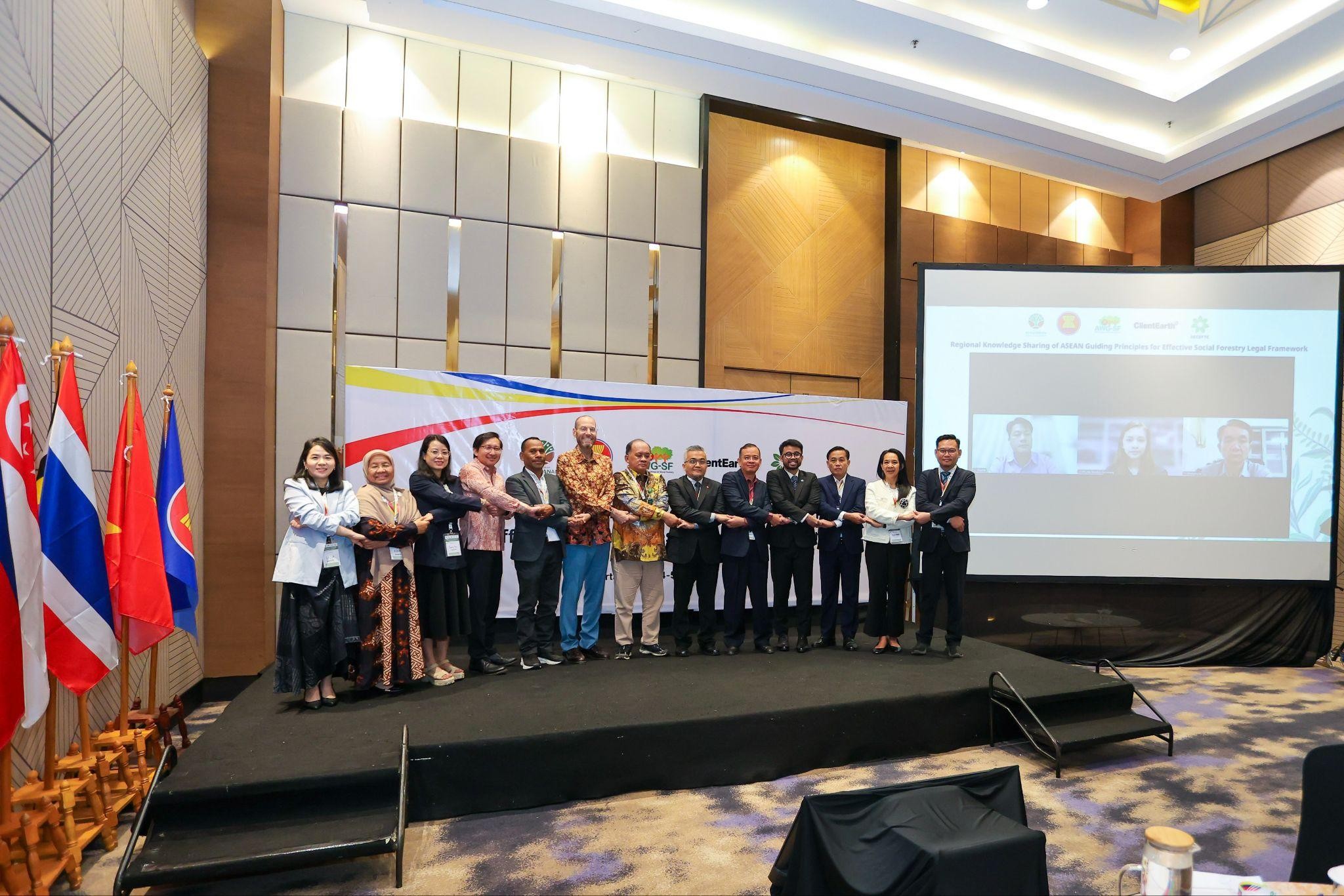
JAKARTA, 4 August 2026 – ClientEarth, together with ASEAN Working Group on Social Forestry (AWG-SF) and RECOFTC Indonesia, organised a Regional Knowledge Sharing of ASEAN Guiding Principles for Effective Social Forestry Legal Frameworks (AGP) workshop in Jakarta on 4-5 August. Hosted by Indonesia’s Ministry of Forestry, the event aimed to improve the effectiveness, transparency, and inclusiveness of social forestry governance across ASEAN Member States.
This hybrid workshop brought together representatives from all 11 ASEAN Member States, along with Indonesian national forestry officials, to facilitate the exchange of experiences, progress, innovative approaches, and best practices in implementing the ASEAN Guiding Principles for Effective Social Forestry Legal Frameworks at the national level.
The workshop was also joined by Dr. Dian Sukmajaya, S.Hut., M.Sc., M.S.E., Senior Officer, Forestry of Food, Agriculture and Forestry Division, ASEAN Secretariat, and Markus Octavianus Susatyo, Director of Social Forestry Management Directorate, Ministry of Forestry Indonesia.
“At the ASEAN level, collaboration on social forestry has continued to grow through regional platforms, shared guidance, and sustained exchanges among Member States. The efforts provide an important foundation for aligning national policies with regional aspirations, strengthening forest tenure and community participation,” said Marcus Octavianus Susatyo, S.Hut., M.P., Director of Social Forestry Management Directorate, Ministry of Forestry,
The AGP, co-developed by ClientEarth and RECOFTC Indonesia with AWG-SF in 2019, provides a shared regional framework to enable and strengthen the legal and institutional environment for social forestry across Southeast Asia. The goal is to ensure Indigenous Peoples and local communities have more effective access to social forestry schemes and the opportunity to participate in sustainable forest management.
“ASEAN emphasised the importance of advancing sustainable forest management and social forestry development through stronger legal and policy frameworks, enhanced institutional capacity, sustainable community livelihoods, and regional knowledge sharing. These priorities aim to strengthen forest governance, support climate and biodiversity goals, and ensure meaningful participation of local communities in the sustainable management of forest resources. Social forestry has a potential role to support the implementation of ASEAN One Billion Trees Growing Initiatives and promotion of the Nature-based Solutions (NbS) / Ecosystem-based Adaptation (EbA) across the region,” said Dr. Dian Sukmajaya, S.Hut., M.Sc., M.S.E., Senior Officer Forestry of Food Agriculture and Forestry Division, ASEAN Secretariat.
This year’s edition is a continuation of the success of a series of capacity-building initiatives that ClientEarth and RECOFTC Indonesia have supported since 2019, including a 2024 regional workshop that identified priority actions for national-level implementation, and a 2025 national training programme for Indonesian forest agencies.
The 2025 national training programmes engaged Regional Social Forestry offices, provincial and district Forest Agencies, and Forest Management Units to strengthen institutional capacity and address systemic and procedural challenges in the social forestry permitting process. With the programmes grounded in the AGP framework, participating officials will be better positioned to translate regional commitments and national policies into practical implementation.
“ASEAN’s mission in social forest management is crucial for our people who live in the forest areas and nearby. As ASEAN member states, we remain committed to jointly promoting and supporting sustainable social forest management under the ASEAN cooperation on Forestry. This strengthens social forestry cooperation through improved legal frameworks, greater community participation, recognition of traditional land tenure rights, and increased adoption of agroforestry systems to support livelihoods, food security, and climate resilience in our region. Therefore, the ASEAN Regional Knowledge Sharing Principles for Effective Community Forest Law Frameworks (AGP) are a key guideline to further drive cooperation in ASEAN’s social forest management,” said Ms. Prattana Meesincharoen, AWG-SF Focal Point for Thailand, the Royal Forest Department of Thailand.
Over two days, representatives from each ASEAN Member State presented on the successes and challenges of social forestry implementation in their respective countries, followed by discussions on shared lessons and opportunities for regional cooperation. Government representatives were also invited to share usable models, regulatory updates, and practical challenges, moving the discussion beyond theory and anchoring it in concrete, replicable solutions.
“What we’ve learned through Indonesia’s experience implementing the AGP is that the practical, sometimes procedural challenges officials face on the ground are exactly what this workshop was designed to share. No single country has all the answers, and that’s the point of coming together,” said Azam Hawari, Lawyer, Food, Oceans, Land Use (FOLU) Japan and Southeast Asia at ClientEarth.
“I am very grateful that representatives from most ASEAN Member States joined this workshop. Although each country has different political systems, cultures, and socio-economic contexts, we all share the same goal. Community forestry contributes to environmental sustainability, economic prosperity, and social equity. Let us turn this shared commitment into action and continue working together for stronger communities and healthier forests across ASEAN,” stated Gamma Galudra, Country Director of RECOFTC Indonesia.
The workshop concluded with reflections from the ASEAN Secretariat on how the shared lessons can support continued national-level implementation of the AGP across the region.
— ENDS —
About ASEAN Working Group of Social Forestry
The ASEAN Working Group on Social Forestry (AWG SF) is a government driven social forestry network in Southeast Asia. It is a transformation of the ASEAN Social Forestry Network (ASFN), a government driven social forestry network in Southeast Asia, with the main goal to strengthen ASEAN Cooperation in Social Forestry through the sharing of information and knowledge. The AWG-SF is an ASEAN Working Group that reports to the ASEAN Senior Officials on Forestry.
The Working Group has an extended objectives and scope of work from the initial ten years of the ASFN that links the government forestry policy-makers directly with other network members from civil society, research organizations, academia, private sector and experts of related fields – all who share a vision of seeing social forestry grow in ASEAN Member States.
About RECOFTC
At RECOFTC, we believe in a future where people live equitably and sustainably in and beside healthy, resilient forests. We take a long-term, landscape-based and inclusive approach to supporting local communities to secure their land and resource rights, stop deforestation, find alternative livelihoods and foster gender equity. We are the only non-profit organization of our kind in Asia and the Pacific. We have more than 30 years of experience working with people and forests, and have built trusting relationships with partners at all levels. Our influence and partnerships extend from multilateral institutions to governments, private sector and local communities. Our innovations, knowledge and initiatives enable countries to foster good forest governance, mitigate and adapt to climate change, and achieve the Sustainable Development Goals of the United Nations 2030 Agenda and the Paris Agreement on climate change.
About ClientEarth
ClientEarth is a non-profit environmental organisation that uses the law to create systemic change that protects the Earth for—and with—its inhabitants. We are tackling climate change, protecting nature and stopping pollution, with partners and citizens around the globe. In Asia, we work with the private sector, civil society and government regulators to support the net zero transition through capacity building and legal analysis on topical issues including climate change, sustainability and the environment. From our offices in Europe, Asia and the USA we help build a future for our planet in which people and nature can thrive together.





Leave A Comment