
 En-ROADS, Inclusive Climate Governance, and Indonesia’s Sustainability Transition
Farhan Helmy
“Climate change is not only an environmental challenge, but also a challenge of inclusion, resilience, governance, and livelihoods. Those most vulnerable to climate impacts must be part of the conversation.”
Representing the Advanced Systems Computing, Design, and Innovation (ASCODI) Lab, in my capacity as the CEO, I met with the Minister of Environment of the Republic of Indonesia, Mr. Jumhur Hidayat in Jakarta, on June 10, to discuss climate governance, sustainability transition, and the implications of climate change for vulnerable communities.
The discussion centred on a simple but critical question: as climate change accelerates, who will be most affected?
While climate policies are often discussed through the lenses of emissions reduction, energy transition, and economic transformation, the discussion emphasized the importance of also considering the experiences of vulnerable populations, including persons with disabilities, older persons, neurodivergent communities, children, and low-income households. These groups often face disproportionate risks from rising temperatures, urban heat stress, environmental degradation, disasters, and disruptions to essential services.
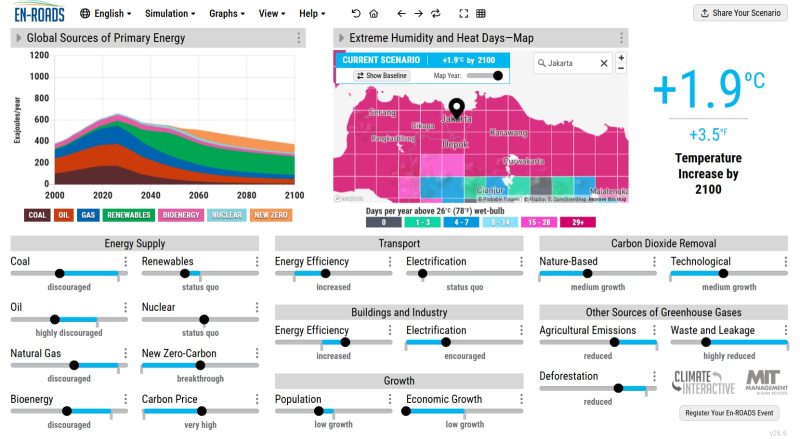
As part of the discussion, ASCODI Lab introduced the En-ROADS Climate Solutions Simulator, a globally recognized climate policy simulation platform developed by Climate Interactive in collaboration with the MIT Sloan Sustainability Initiative. Today, En-ROADS has been utilized by stakeholders across more than 169 countries as a tool to support climate literacy, policy dialogue, systems thinking, and collaborative decision-making.
Importantly, En-ROADS is not intended to provide quick-fix solutions or prescribe a single policy pathway. Rather, it serves as a platform to explore the dynamic interactions within climate, energy, land use, economic, and technological systems. Through nineteen interconnected policy levers and variables, users can examine how different interventions influence future climate outcomes and better understand both the short-term and long-term consequences of policy decisions.
Using En-ROADS, the discussion demonstrated how climate decisions made today can shape future environmental conditions and how these impacts ultimately translate into real-world challenges faced by communities. The conversation highlighted the importance of connecting climate policy, systems thinking, and inclusive development to ensure that no one is left behind in Indonesia’s sustainability transition.
Minister Jumhur Hidayat expressed appreciation for the initiative and recognized the value of systems-thinking tools such as En-ROADS in strengthening climate literacy and evidence-based policymaking. He also agreed that the platform has significant potential to support capacity building and strategic dialogue among policymakers at various levels, including national policy decision-makers, regional governments, and State-Owned Enterprises (SOEs).
The discussion also explored how Indonesia could potentially utilize En-ROADS not only for domestic policy dialogue, but also as a strategic engagement tool within regional and international platforms where Indonesia plays an active role, including ASEAN, the G77, BRICS, and other multilateral forums. Shared simulation exercises can help policymakers better understand common challenges, policy trade-offs, and potential pathways toward sustainable development and climate resilience.
Beyond policymaking, the conversation highlighted the importance of climate literacy and education. Teachers, lecturers, and educators play a critical role in shaping future generations’ understanding of climate change. Equipping educators with systems-thinking tools such as En-ROADS could help foster a broader climate literacy movement, enabling students to better understand the complexity of climate challenges and the interconnected nature of sustainability decisions. Over time, this can contribute to building a society that is better prepared to navigate the uncertainties and opportunities associated with climate change.
Another key theme was the importance of coordination among stakeholders. Climate action often involves multiple ministries, local governments, businesses, State-Owned Enterprises, civil society organizations, academic institutions, and community groups. One of the strengths of En-ROADS is its ability to create a shared space for dialogue, allowing participants to develop a common understanding of system dynamics, delays, leverage points, trade-offs, and potential impacts. By helping stakeholders visualize how different policy choices interact, the platform can support more informed and coordinated decision-making.
The discussion also explored how systems-thinking tools such as En-ROADS can support policymakers in addressing some of Indonesia’s most persistent environmental and sustainability challenges. Issues such as waste management in rapidly growing urban areas, deforestation, land-use change, energy transition, and sustainable development planning require coordinated action across sectors and institutions. By helping decision-makers understand the interactions between policy interventions and long-term climate outcomes, En-ROADS can serve as a valuable platform for fostering more coherent and consistent pathways toward a low-carbon and climate-resilient economy.
I also highlighted the importance of strengthening discussions around climate impacts, particularly loss and damage. While mitigation and energy transition often receive significant attention, developing countries such as Indonesia continue to face increasing costs associated with climate-related disasters and environmental degradation.
Hydrometeorological disasters (floods, droughts, extreme rainfall, landslides, coastal inundation, and heat-related events) are becoming increasingly frequent and costly. Without adequate adaptation measures, international cooperation, and effective climate finance mechanisms, many of these costs will ultimately need to be borne through national and local fiscal resources.
Understanding these long-term implications is essential for building resilience and informing more strategic policy decisions.
Another important dimension of the discussion was the relationship between climate policy and employment. The transition toward a low-carbon economy will create new opportunities in renewable energy, sustainable industries, circular economy initiatives, waste management, ecosystem restoration, climate-smart agriculture, blue economy sectors, and climate adaptation. At the same time, the transition may also affect existing industries and workers if not managed carefully.
Given Minister Jumhur Hidayat’s longstanding commitment to labour rights and worker welfare, the discussion highlighted the importance of a just transition, one that balances environmental objectives with economic opportunity, social protection, skills development, and decent work. Climate action should not be viewed as a constraint to development, but rather as an opportunity to create more resilient economies and sustainable livelihoods. Systems-thinking tools such as En-ROADS can help policymakers better understand these trade-offs and identify pathways that support both climate action and inclusive economic development.
The discussion also touched on the broader global context in which climate policy is being developed. Climate change does not recognize national borders, yet the international response increasingly faces challenges from geopolitical tensions, competing economic priorities, and signs of declining multilateralism. At a time when some countries are reconsidering or weakening aspects of their climate commitments under frameworks such as the Paris Agreement, developing countries continue to face growing climate risks despite having contributed comparatively less to historical greenhouse gas emissions.
This reality underscores the importance of strengthening cooperation among developing countries and regional blocs, including ASEAN, the G77, BRICS, and other Global South partnerships. In an increasingly fragmented geopolitical landscape, developing countries have an opportunity to play a more active role in shaping solutions that are not only environmentally effective but also socially inclusive and economically realistic. Platforms such as En-ROADS can help facilitate constructive dialogue, support evidence-based policymaking, and foster a shared understanding of long-term consequences, trade-offs, and opportunities for collective action.
Looking ahead, the discussion also touched on the importance of strengthening Indonesia’s leadership role within regional and global climate dialogues, particularly as the international community prepares for future rounds of climate negotiations, including COP31 and beyond.
As the world’s largest archipelagic nation and one of the planet’s most biodiverse countries, Indonesia occupies a unique position in the global climate landscape. Its vast forests, marine ecosystems, coastal communities, and growing economy place it at the intersection of climate mitigation, adaptation, biodiversity conservation, and sustainable development. As a leading voice within ASEAN, the G77, and broader Global South forums, Indonesia is well positioned to help bridge discussions between climate ambition, social inclusion, economic transformation, and resilience. This role is becoming increasingly important as countries seek pathways that simultaneously address emissions reduction, adaptation, employment, poverty alleviation, biodiversity protection, ocean governance, and environmental sustainability.
In this context, Minister Jumhur Hidayat and the Ministry of Environment have an opportunity to contribute not only to Indonesia’s domestic climate agenda but also to broader international conversations on systems thinking, climate resilience, loss and damage, just transition, climate literacy, biodiversity conservation, and the inclusion of vulnerable communities within climate policy. As climate challenges become increasingly interconnected, the ability to facilitate dialogue across sectors, institutions, and countries may become as important as any individual policy intervention itself.
The meeting also served as an opportunity to introduce ASCODI Lab’s broader framework on Inclusive Climate and Sustainability Transition, which integrates climate governance, ecological intelligence, urban resilience, vulnerable community perspectives, and multi-stakeholder collaboration. The framework seeks to bridge policy, science, technology, and community action while ensuring that sustainability efforts remain grounded in the realities faced by people and places.
As Indonesia navigates an increasingly complex climate and sustainability landscape, there is a growing need for tools and approaches that help policymakers understand the dynamic interactions, trade-offs, and long-term consequences of different policy choices. Climate governance is rarely a linear process. It involves balancing environmental objectives, economic development, energy security, social inclusion, and political realities. Strengthening climate resilience therefore requires not only reducing emissions, but also improving coordination among stakeholders and ensuring that the voices and experiences of vulnerable communities are reflected in policy design and implementation.
Climate change is not merely an environmental challenge. It is simultaneously a governance challenge, a development challenge, a social inclusion challenge, and increasingly a question of how societies manage complexity, uncertainty, and long-term resilience. Addressing these interconnected challenges requires a shift from siloed thinking toward more integrated and systemic approaches.
The meeting reinforced the importance of moving beyond fragmented approaches toward systems-based solutions that connect climate policy, sustainability, social inclusion, economic opportunity, biodiversity conservation, and long-term resilience. As Indonesia continues to navigate the opportunities and challenges of sustainable development, platforms such as En-ROADS can help create a shared understanding among stakeholders and support more informed, collaborative, and future-oriented decision-making.
ASCODI Lab looks forward to continuing collaboration with government institutions, academia, civil society organizations, State-Owned Enterprises, development partners, and sustainability practitioners to advance inclusive, science-based, and systems-oriented solutions for Indonesia’s future.
–##–






Leave A Comment